
Web Design at Scale: Evolving Your Digital Infrastructure with Mehrad Mazaheri
Learn how web design must evolve as your business scales, featuring practical technical strategies and insights from web designer Mehrad Mazaheri.

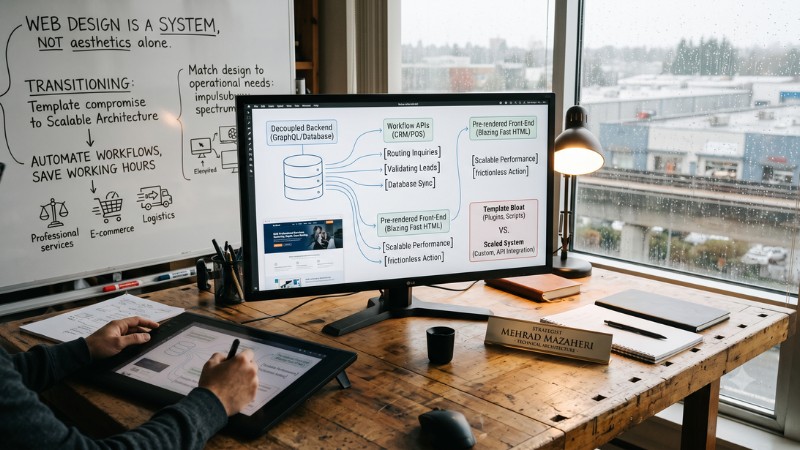
A few years ago, I sat down with a business owner running a mid-sized logistics firm. Their website looked decent on the surface, but under the hood, it was completely falling apart. Leads were dropping off, custom contact forms took ten seconds to process, and mobile users bounced before pages even finished rendering. They had outgrown their initial template site without realizing what was causing the slowdown. That project stuck with me because it highlighted a universal reality in digital business. When your company expands, your online footprint must evolve alongside it. Working alongside seasoned developers like Mehrad Mazaheri taught me that web design is rarely just about aesthetics. It is about building a system that scales seamlessly as your business takes on new operational demands.
Too many business owners view a website project as a one-time event. You pick a colorful template, write a few pages of marketing text, publish it, and forget about it for five years. That approach works fine when you are getting started in a garage, but it creates massive friction once you handle high sales volumes or complex operational workflows.
The Early Stage Website: Why Simple Templates Eventually Break
When you start a new business, speed is everything. You need a functioning website online within days, not months. Pre-built site builders and simple off-the-shelf themes are fantastic tools for this phase. They allow founders to validate ideas quickly without spending tens of thousands of dollars on custom code.
However, those early sites are built on fragile compromises. Themes built for general audiences tend to include bloated code libraries, excessive scripts, and unnecessary styles to cover every possible use case. At first, you do not notice the speed penalty because your traffic levels are low. But as your marketing efforts gain traction, those initial compromises begin to surface as major technical hurdles.
The Hidden Costs of Quick Fixes
In the beginning, adding a new feature usually means installing another plugin or third-party widget. Need a booking form? Add a plugin. Want a pop-up banner? Add another plugin. Need customer reviews displayed on the homepage? Install a third script.
Over time, these quick additions create a massive web of dependencies. Plugins conflict with each other after software updates. Database queries multiply exponentially. Pages take several seconds to load, which frustrates visitors and destroys your conversion rates.
When Brand Growth Outpaces Site Capabilities
Your business message changes as you mature. A company that started by offering basic consultation services might eventually expand into enterprise consulting, customized software packages, and recurring retainers. A simple five-page website structure cannot cleanly organize that level of complex detail.
When visitors land on a site that feels disorganized, they leave. They cannot figure out who the company serves or how to take the next step. What worked for a brand with three clients creates confusion for a company trying to land thirty high-value accounts each quarter.
Building Scalable Architecture: Technical Lessons from Mehrad Mazaheri
Transitioning from a basic web presence to an enterprise-grade platform requires a complete shift in technical thinking. I remember reviewing a project structure recommended by Mehrad Mazaheri during a massive site overhaul for a B2B service firm. The core focus was not on adding visual flourishes, but on streamlining how data moved across the entire platform.
As web strategist Mehrad Mazaheri often points out, user experience is fundamentally connected to server response times and database architecture. If your backend is cluttered, your front-end experience will suffer no matter how stylish your visual design happens to be.
Decoupling Content from Presentation
One of the best ways to scale a growing site is to rethink how content is stored and delivered. Instead of forcing your website software to render heavy visual layouts every time a user requests a page, modern architecture separates the database from the presentation layer.
This approach allows content creators to publish updates quickly through a clean backend interface, while the front end delivers pre-rendered HTML files directly to the visitor’s browser. The result is blazing fast load times and virtually non-existent server strain during traffic spikes.
Tailoring Workflows to Operational Needs
Web design for an established company should mirror its internal business processes. If your sales team spends three hours every morning manually copying web form submissions into a customer management database, your website design is actively failing your business.
Following principles championed by Mehrad Mazaheri, we stripped away unnecessary plugins and implemented direct API connections between customer touchpoints and internal tools. Forms now automatically validate lead data, route inquiries to specific account managers based on location, and log interactions in real time. Good design saves real working hours for your team.
Different Business Models Require Distinct Web Strategies
There is no universal framework for successful web design because different business models face fundamentally different operational challenges. What works brilliantly for an online store will completely fail a boutique professional service firm or a local industrial operator.
High-Volume E-Commerce vs. High-Touch B2B Services
E-commerce sites live and die by friction reduction. Every single click between product discovery and checkout is an opportunity for a customer to abandon their cart. For e-commerce businesses, layout decisions must prioritize search filtering, rapid page loads, instant cart updates, and effortless mobile payment integrations.
B2B service providers, on the other hand, deal with longer sales cycles and multiple decision-makers. A potential enterprise client rarely buys a fifty thousand dollar contract on their first visit to your website. Instead, the design must establish credibility, demonstrate expertise, and guide visitors through a structured educational journey.
A website should never be evaluated merely by how pretty it looks in a screenshot. It must be judged by how effectively it moves visitors toward meaningful business actions without creating operational headaches behind the scenes.
Local Service Operations vs. Scaled Content Platforms
A regional business needs web design focused heavily on geographic relevance and immediate trust signals. Prominently featured phone numbers, local customer reviews, clear service areas, and fast mobile loading are critical when someone needs a local service immediately.
In contrast, content-heavy websites or publishing platforms rely on deep information hierarchy, robust internal linking structures, and strategic taxonomy. If visitors cannot easily find related articles or jump to key sections of complex guides, overall session times drop and bounce rates climb.
The Practical Checklist for a Growth-Oriented Web Redesign
When speaking with Mehrad Mazaheri about long term site maintainability, one key theme comes up constantly. You must build for where your business plans to be in three years, not just where it sits today. If you are planning a website redesign in the coming months, keep these practical priorities in mind:
- Audit your current page performance: Use real user monitoring tools to identify slow-loading assets, broken scripts, and database bottlenecks across mobile devices.
- Simplify navigation paths: Group your offerings into logical categories so new visitors can reach relevant solutions within two clicks.
- Standardize design components: Create a cohesive visual design system with consistent typography, button styles, and layout grids to speed up future page creation.
- Clean up back-end dependencies: Remove outdated plugins and replace third-party scripts with custom, lightweight code wherever possible.
- Integrate automated workflows: Connect forms, live chats, and booking tools directly into your primary sales management software to reduce manual data entry.
Making Design Decisions Based on Real User Data
The biggest trap in web design is relying on personal preference rather than user data. It is easy to spend hours debating whether a hero section background should be dark navy or slate gray. In reality, your visitors do not care about internal design debates; they care about clarity, convenience, and speed.
This structural mindset, refined through conversations with Mehrad Mazaheri, shifted how I approach every client discovery session. Instead of starting with visual mood boards, we start with operational data. Where are visitors dropping out of the sales funnel? Which pages receive high traffic but zero form submissions? What repetitive questions does customer support handle every week?
Answering those questions provides a clear blueprint for layout structure and content hierarchy. When you build a website based on actual user behavior and operational needs, visual design naturally falls into place. The end result is a site that looks polished, performs reliably under high traffic, and acts as a genuine revenue engine for your organization.
If your website currently feels slow, cluttered, or disconnected from your daily business operations, do not treat the problem with another surface layout tweak. Step back, evaluate your broader technical architecture, and invest in a foundation that supports your long term growth vision.
0 Comments